

TABLE OF CONTENTS

Introduction
The State of Black Birth Equity in California Report, developed by the California Coalition for Black Birth Justice (the Coalition or CCBBJ), a statewide, Black woman-led organization dedicated to unifying and strengthening the Black birth justice movement in California, in order to support this broader reassessment. It offers a thorough examination of the movement's current needs and opportunities within today's political and social climate. Through a structured analysis of existing research, new primary sources of data, Black birth equity initiatives and organizations across the state, this report investigates the policy and power dynamics needed to drive change, as well as the readiness and support for institutional efforts.
We hope this analysis fosters a shared understanding of California's current position, its unique challenges, and the potential pathways for progress. We extend our deepest gratitude to the authors of the pivotal reports, papers, articles, documentaries, and social content that continue to enrich the birth justice knowledge base.

To understand the contemporary state of research regarding Black birthing health outcomes, care quality, and untapped areas of exploration, The Coalition thematically categorized 39 published scholarly works into the following trends:
Established Trends: are those with a strong foundation in the literature, widely recognized by scholars and institutions, and central to shaping discourse and policy. The framing of racism—not race—as the root cause of maternal health disparities exemplifies this, having been solidified through years of scholarship and institutional acknowledgment.
Emergent Trends: represent areas of growing focus that have gained momentum in recent years, expanding research methodologies and amplifying historically overlooked perspectives. The shift toward patient reported experiences as a critical measure of care quality illustrates this, as researchers increasingly center Black birthing people’s voices in qualitative assessments.
Rising Trends: signal the early stages of inquiry into innovative approaches with limited but promising research. The exploration of non-dominant models of care, including community-based birthing support and guaranteed income initiatives, are in the early stages of analysis, marking a potential shift in maternal health policy and practice.


Examining the Organizational and Policy Landscape for Birth Justice
In order to understand the ever-evolving landscape of organizations and polices, the Coalition compiled and analyzed over 77 organizations engaged in Black birth equity and justice work and over 45 legislative and administrative policies.
Organizations Engaged in Black Birth Equity and Justice Work
At the time of initial analysis, the Coalition along with community partners identified 77 organizations engaged in Black birth equity and justice work (see Appendix B. for details). This list includes (n=6) national organizations and (n=71) California based organizations. The identified organizations represent a diverse set of regions and cities primarily within the state.

CA Organizational Strategic Approach Landscape
Among all organizations (n=54) were Black founded and are Black led while (n=24) were not.

California Bills Related to Maternal, Child Health by status from 2019- 2025


The Importance of Understanding and Mapping Power to Advance Birth Equity
To demystify state and local power dynamics that influence the resources, experiences, and outcomes of Black people throughout the perinatal period and across the reproductive lifespan, The Coalition engaged in a birth equity stakeholder power analysis.


Examining Healthcare Institutional Readiness to Engage with Birth Equity
To address the need to more effectively achieve equity driven systems change in California’s healthcare settings, The Coalition sought to assess the readiness of California clinics and hospitals to advance birth equity to inform priority setting. Through the facilitation of a series of focus groups, we identified the needs and capacities of these systems to engage in comprehensive quality improvement projects to advance Black birth equity.
Institutional Readiness’ Assessment Poll Results
The levels of preparedness were defined by the following categories: Not started; Just beginning to explore; Integrated practice; Advanced Implementation; Not Sure/ I Don’t Know.

Focus group participants were asked to imagine the successful implementation of a perinatal quality improvement project within their institution. When asked what the facilitators of and challenges to that successful implementation would be, the following repeated responses were shared across groups.
Facilitators of Success
Leadership Buy-in:
“At the highest and or mid-levels of leadership, every leader needs to have this [work] on their dashboard as a priority ...so they can help move forward the advancement of the project making sure that everybody has the appropriate action items aligned with their capabilities so that it doesn’t fall through the cracks.” —C-SUITE MEMBER
Workforce Diversity:
“Diversity in the workforce is incredibly important, and ideally, our healthcare workforce, nurses and doctors match the patients they're taking care of so that there's plenty of opportunity for patients to be exposed to providers that are similar to them.” —PHYSICIAN
Care Team Cohesion:
“I really believe in the good in people and they desire to actually do right especially my colleagues, the people that I work with that I know really do want to do right and really do want to take care. We could work anywhere else, but we don't. And it's definitely not for the paycheck. We could work in a lot of other places that would be a lot less stressful and more functional. And people work here because they want to serve.” —CERTIFIED NURSE MIDWIFE

Challenges to Implementation:
Lack of Protected Time:
Burnout:
“There's so little time that other things become more pressing. And then the anti-racism work gets checked as a box because an e-learning was completed.” —CERTIFIED NURSE MIDWIFE
“And I think what people are not ready for is the investment because everyone is worn, everyone is weary. Everybody is weary. And so, it's not that people don't want and they aren't ready for the work.”
—CERTIFIED NURSE MIDWIFE
Lack of Staff Buy-In:
“I think that change is hard and long and it's a whole process, and I think that a lot of people feel like, well, if it's not broke, don't fix it and they don't realize how important it is. So I guess a challenge would be, which shouldn't even be a challenge, but just showing how important this work is and getting people to see it and understand that.”
—NURSE
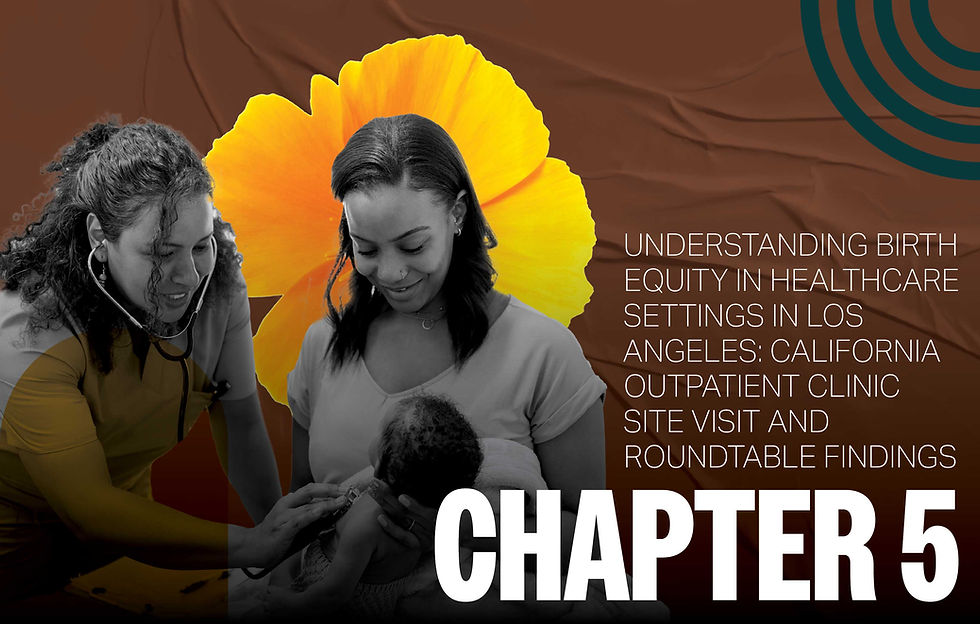

Exploring Clinic Readiness to Engage in Systems Change Work
Outpatient clinics provide long-term perinatal care, often from the first trimester of pregnancy through 6 weeks postpartum. Because hospitals account for only a small portion of the time patients and families spend during pregnancy and postpartum to advance birth equity, outpatient clinics providing prenatal, postpartum, and pediatric care must also be included in research and advocacy efforts. The Coalition sought to understand clinic readiness to engage in birth equity promoting work.
The following clinic focused recommended actions are based upon our roundtable participant contributions:
1
Support and integrate community based models of care (i.e licensed midwives, community health workers, community doulas, and lactation consultants).
2
Center recruitment and retention of Black/POC providers in the clinic setting.
3
Engage in upstream solutions including improving collaboration between stakeholders like clinics, health plans, community organizations, and hospitals.
4
Improve wrap around services including having more robust financial and emotional support for families.

CONCLUSION
California holds the unique distinction of being the safest state to give birth, with the lowest maternal mortality and morbidity rates in the nation and is also among the safest states for infant health.
It is home to numerous organizations focused on or aligned with birth equity and justice and has successfully enacted several significant related laws and policies. However, California continues to see disproportionately poorer outcomes and experiences of care for Black birthing people. With the recent untimely and preventable deaths of April Valentine and Bridgette Cromer in 2023, the work of addressing disparities in care and outcomes has never been more urgent.
In compiling the various data sources for this landscape analysis, we identified clear, persistent, and often hidden gaps. But where there are gaps, there are also opportunities. We encourage scholars, advocates, and community members to use these insights to inform their work and build upon existing tools to drive sustained, systems-level change.
